Scaphoid Fracture
Downloadable scaphoid fracture resource
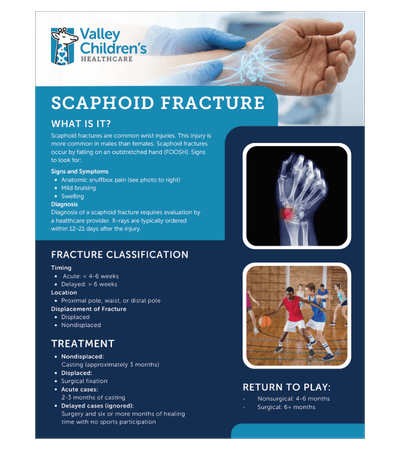
Valley Children's Orthopaedic Department has developed a free downloadable scaphoid fracture flyer for school coaches and athletic directors.
Overview
A scaphoid fracture is one of the most common wrist injuries in children and adolescents, particularly in active youth and teenage athletes. This type of fracture involves the scaphoid bone — a small but critical bone located on the thumb side of the wrist — and is most often caused by a fall onto an outstretched hand (FOOSH).
Due to the fact that the scaphoid bone has a limited blood supply, early diagnosis and appropriate treatment are essential to promote healing and prevent long-term complications.
Signs and Symptoms
Children with a scaphoid fracture may experience:
- Pain and tenderness in the anatomic snuffbox (the hollow area at the base of the thumb)
- Mild bruising around the wrist or thumb
- Swelling of the wrist
- Pain with gripping, pinching or wrist movement
- Decreased wrist strength or range of motion
Diagnosis
Our team has specialized training and extensive experience with diagnosis and treatment of a scaphoid fractures which require evaluation by a specialist because early X-rays may not always show the fracture. Imaging is often repeated 12 to 21 days after injury to confirm the diagnosis. Additional advanced imaging may be recommended if needed to assess healing and blood supply.
Fracture Classification
- By Timing
- Acute: Less than 4–6 weeks from injury
- Delayed: More than 6 weeks after injury
- By Location
- Proximal pole
- Waist (most common)
- Distal pole
- Displacement of Fracture
- Nondisplaced: Bone fragments remain aligned
- Displaced: Bone fragments have shifted
Treatment Options
Treatment depends on the location, timing and stability of the fracture.
- Nondisplaced fractures: Treated with casting for approximately 2–3 months, with regular follow-up imaging to monitor healing.
- Displaced fractures: Typically require surgical fixation to realign and stabilize the bone.
- Delayed or ignored fractures: Often require surgery and may involve six months or longer of healing time, with restrictions from sports and high-impact activities.
Return to Sports and Activities
- Nonsurgical treatment: Return to play is typically allowed in 4–6 months once healing is confirmed.
- Surgical treatment: Return to sports may take 6 months or longer, depending on healing progress and sport-specific demands.
Why Early Treatment Matters
Prompt diagnosis and specialized pediatric hand and upper extremity and/or orthopaedic care help prevent complications such as delayed healing, nonunion and chronic wrist pain — allowing children to return safely to school, sports and daily activities.